
Basement leaks in Vineland, NJ come from seven causes: poor grading, clogged or misrouted gutters and downspouts, hydrostatic pressure, cracked foundations, failing sump pumps, defective window wells, and leaky interior plumbing. The sections below explain how each cause lets water in. Vineland sits on sandy loam Coastal Plain soils over Kirkwood-Cohansey sediments, which pass water quickly to the foundation.
Key Takeaways
- Poor grading sends runoff toward the foundation. The ground must fall 6 inches in the first 10 feet (5%) away from the house.
- Clogged gutters and short downspouts dump roof runoff at the footing.
- High water tables create hydrostatic pressure that causes cove-joint seepage, slab weeping, and bowed walls.
- Foundation cracks and failed sealants let water in at four crack types.
- Window well drainage failures funnel water to the wall.
What causes poor grading to leak a basement?
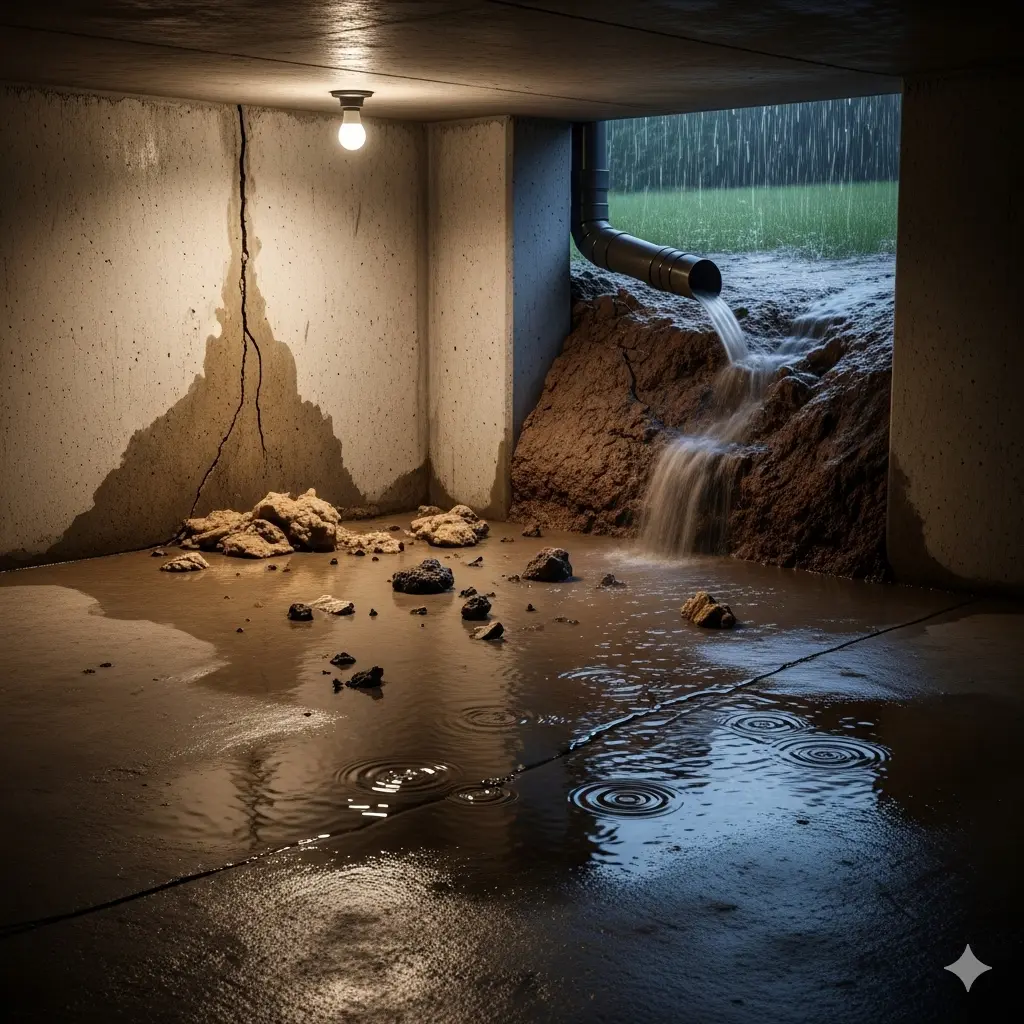
Negative grading slopes the ground toward the foundation, so runoff collects at the wall-footing joint. Code requires the ground to fall 6 inches in the first 10 feet (5%) away from the house (IRC R401.3). Flatter or reversed slopes drive water into the basement.
Sandy loam Coastal Plain soils pass runoff downward quickly, so even a 1-2% back-pitch funnels water to the footing and amplifies hydrostatic pressure. A 4-foot level or laser confirms the grade. Perimeter swales, solid conveyance piping to daylight, and French drains set below finish grade carry water away from the wall. Splash aprons at hose bibbs and sealed utility penetrations close the remaining paths.
How do clogged gutters cause basement leaks?
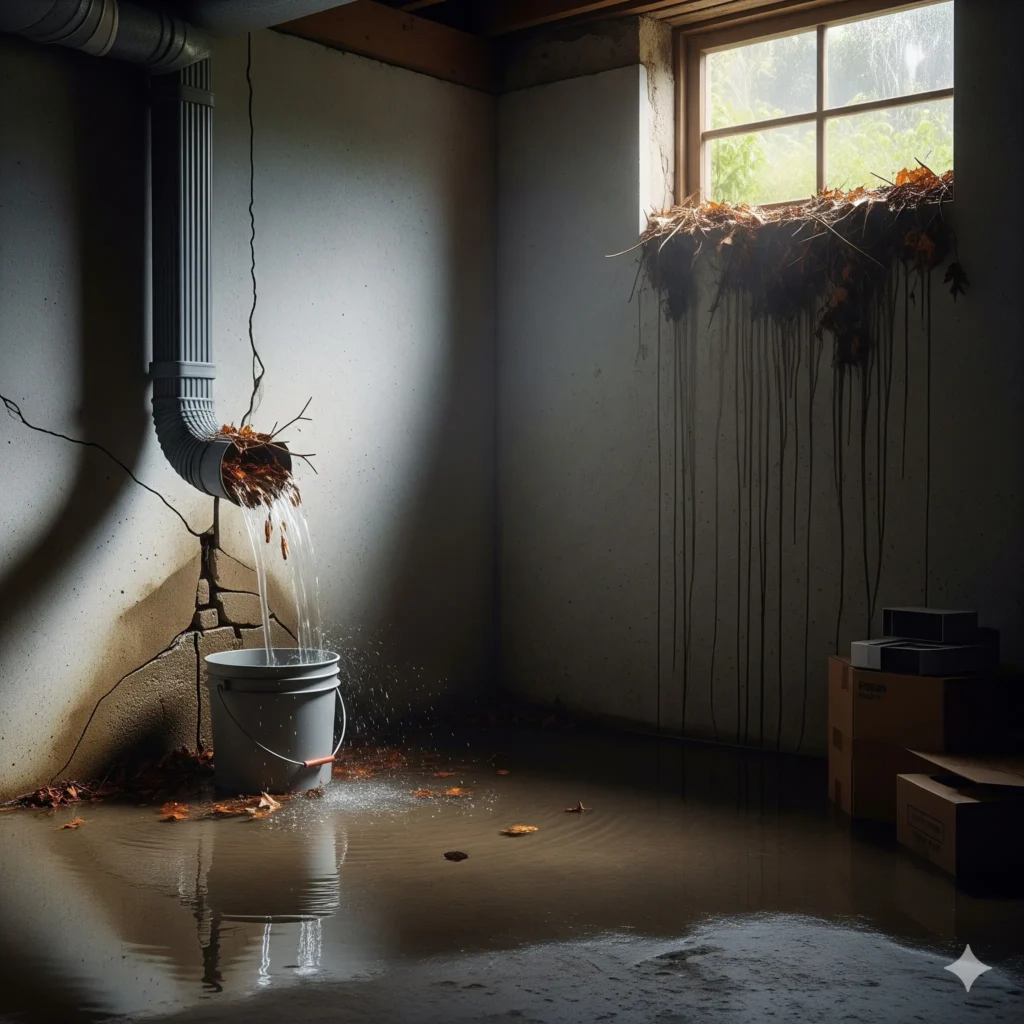
Clogged gutters sheet roof runoff over the edge and concentrate it at the footing. One inch of rain on a 1,200 sq ft roof sheds about 748 gallons, and short or blocked downspouts deliver that volume beside the foundation wall.
One inch of rain on one square foot of roof is 1/12 cubic foot, or about 0.623 gallons (7.48 gallons per cubic foot divided by 12). A 1,000 sq ft area sheds about 623 gallons in the same rain. Gutters need cleaning twice a year and a slope of 1/16 to 1/8 inch per foot toward the outlets. Downspouts terminate 6 to 10 feet from the foundation through solid extensions or buried PVC to daylight, never perforated pipe. Reverse-slope grade at discharge points sends the water back to the wall.
How does hydrostatic pressure cause basement leaks?
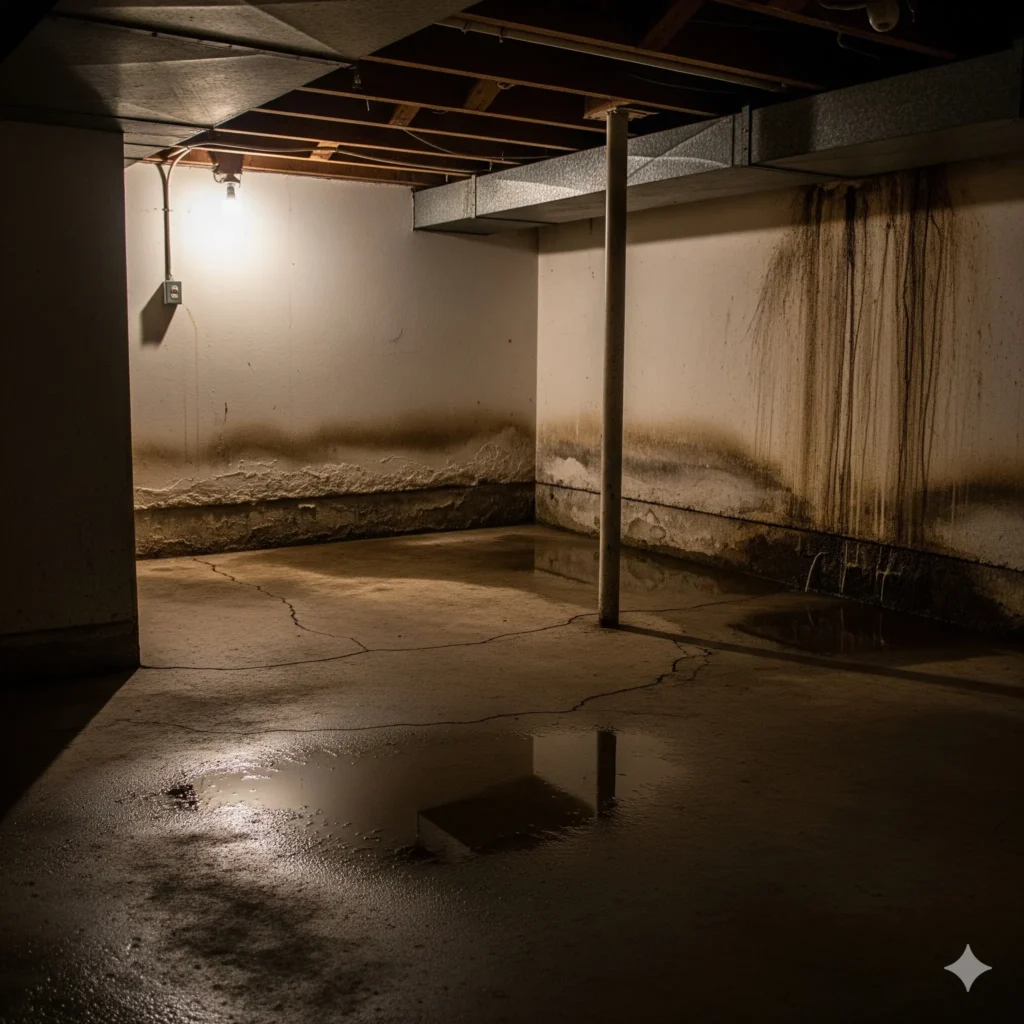
Hydrostatic pressure forces groundwater through joints, cracks, and slab pores when a high water table saturates the soil. Pressure rises about 0.433 psi per foot of depth, so a 6-foot water column pushes about 2.6 psi against the base of a wall.
Persistent cove-joint seepage, floor slab weeping, efflorescence bands, seasonal sump cycling spikes, and buoyant floor tiles signal the pressure. Interior and exterior drains, a properly sized sump with check valve and battery backup, and grading and downspout discharge that keep the water table lower around the footing relieve it.
What Hydrostatic Pressure Does
Hydrostatic pressure acts perpendicular to basement walls and slabs and seeks the path of least resistance. Water weighs 62.4 pounds per cubic foot, which gives 0.433 psi per foot of depth (62.4 divided by 144). A 6-foot water column therefore pushes about 2.6 psi, or about 374 pounds per square foot, at the base of a wall.
That force exploits hairline cracks, cold joints, and utility penetrations. The pressure differential drives water through capillaries and porous concrete, erodes fines, and undermines foundation stability. Unmanaged pressure bows walls, lifts slabs, and overloads seals and cove joints.
- Increases lateral earth pressure on the wall.
- Raises uplift forces beneath the slab.
- Enlarges micro-fissures into leak conduits.
Signs of Rising Water
Damp cove joints where the slab meets the wall are the classic sign of rising water.
- Hairline cracks that darken after rain.
- Efflorescence bands at consistent elevations.
- Blistering paint.
- A frequently cycling sump pump or a high static water level in the pit.
- Moisture halos, rusting sill plates, and swollen bottom plates at utility penetrations.
- Fine sediment lines (“tide marks”) on the slab that map hydrostatic peaks.
Relative humidity above 60% with a musty odor indicates persistent vapor drive. Dated notes on rainfall totals and recurrence intervals show the pattern. Weather drives these cycles, as covered in how Cumberland County weather impacts basement water problems.
Mitigation and Drainage
Mitigation under hydrostatic load relieves pressure and controls pathways. An interior French drain at the footing, pitched to a sealed, battery-backed sump, gives water a controlled exit. Cleanouts and discharge backflow protection keep it working. Negative-side crystalline coatings on walls and elastomeric sealants at cove joints block capillary entry.
- Interior French drain with airtight sump lid and check valve.
- Exterior footing drains with filter fabric and washed stone.
- Bentonite or elastomeric membranes as water barriers.
Full repair steps are in how to fix a leaking basement.
How do foundation cracks let water in?
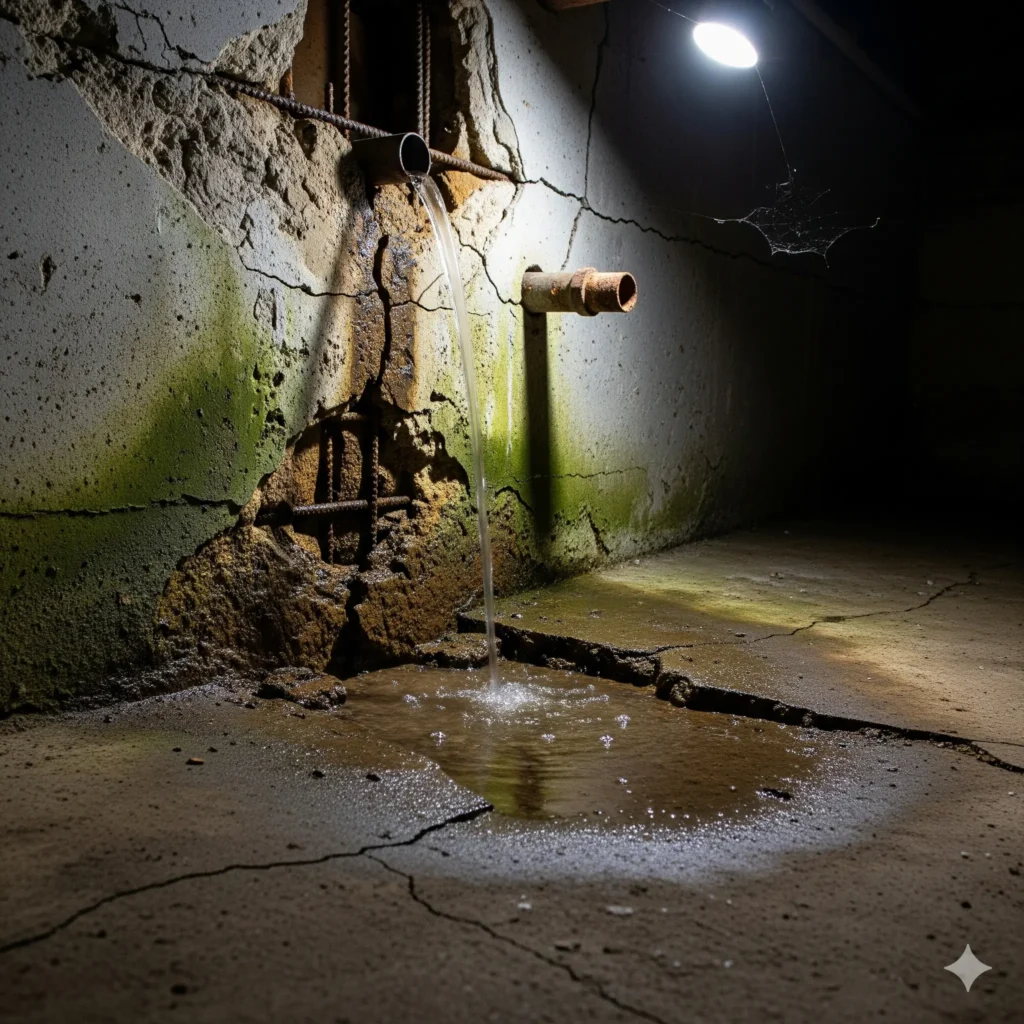
Four crack types leak: hairline shrinkage cracks rarely leak; vertical or diagonal settlement cracks can seep; horizontal cracks in poured walls signal lateral soil pressure; stair-step cracks follow mortar joints in block walls.
| Crack type | Cause | Leak behaviour |
|---|---|---|
| Hairline shrinkage | Concrete curing shrinkage | Rarely leaks |
| Vertical or diagonal settlement | Differential settlement | Can seep at the crack |
| Horizontal, with bowing | Lateral soil and water pressure | Active leak, structural concern |
| Stair-step in block | Settlement or lateral load | Weeps at mortar joints |
Moisture cycles and freeze-thaw pry joints open, and fractures and spalling create direct water pathways under hydrostatic pressure. Efflorescence, damp corners, and slab heave mark the entry points. A foundation inspection maps crack width, displacement, and moisture readings. Structural cracks and active leaks have different repairs, covered in how to fix a leaking basement.
How do failed sump pumps cause leaks?
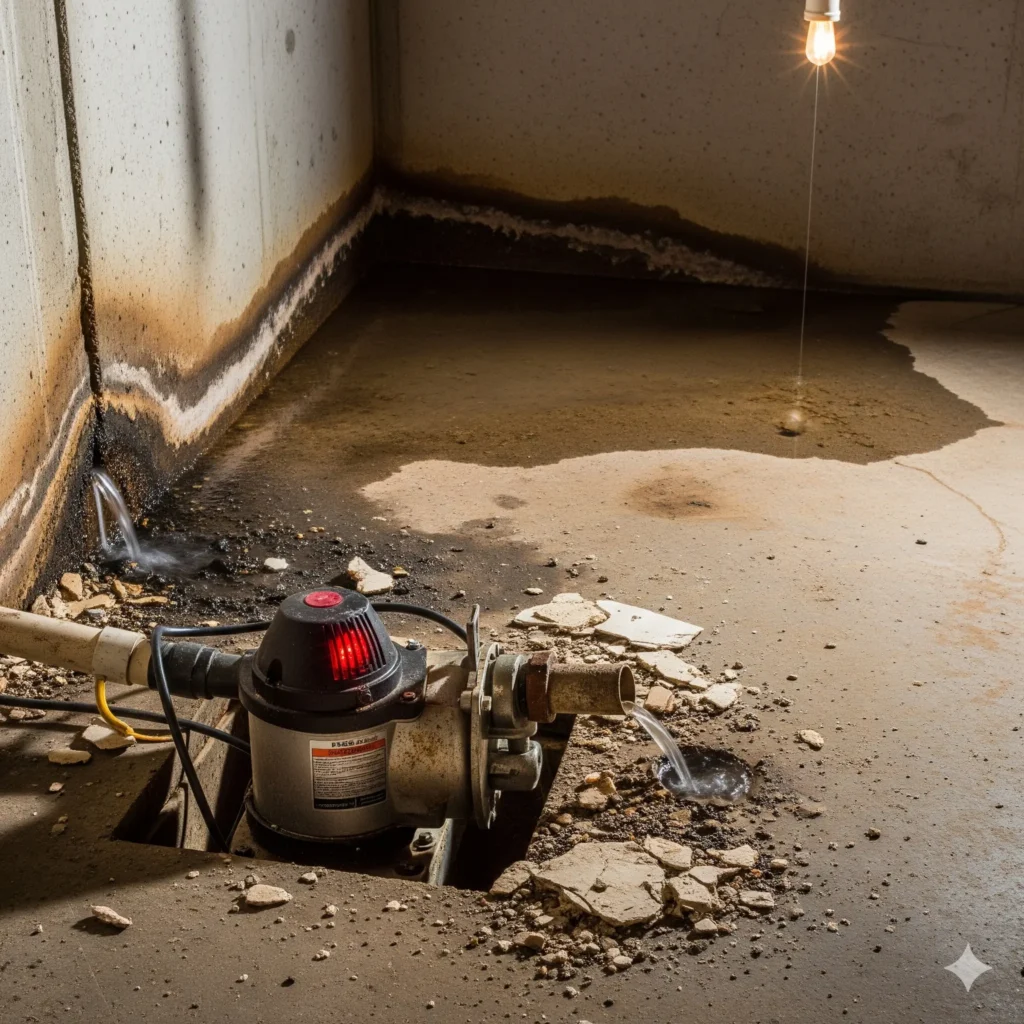
A sump pump fails when it undersizes the inflow rate, loses power, stalls from debris, or discharges into a frozen line. Hydrostatic pressure then overwhelms the basin and pushes water through joints and cracks.
Storm surges in Vineland’s sandy loam soils exceed a single-stage pump’s head and GPM. A failed float switch or frozen discharge line backs water into the basin. A right-sized primary pump, a dedicated circuit, and a tested battery or water-powered backup prevent the failure.
- Install a primary pump sized for the inflow rate and a battery or water-powered backup.
- Test the pump quarterly, clean the intake screen, and exercise the check valve.
- Use a sealed, vented basin, union fittings, a quiet check valve, and an exterior air gap.
How do window wells leak?

Window wells leak when drains clog, gravel is missing, or grading slopes toward the well, so water pools against the window frame and wall. Cracked sealant and warped frames add direct infiltration paths at the foundation interface.
A controlled hose run through the well confirms the flow path. Window perimeters need a check for cracked or failing seals.
Poor Window Well Drainage
Wells without adequate gravel, with clogged drains, or with poor grading build hydrostatic pressure that forces water against the window frame and into the wall cavity. The drain tile must tie into a working perimeter system.
- Keep covers intact and clear debris from the well.
- Add a vertical drain pipe with filter sock tied to the footing drain.
- Regrade soil away from the well and extend downspouts 6 to 10 feet.
Cracked or Failing Seals
Cracked sealant joints and warped window frames let water bypass capillary breaks and gaskets at the well-to-foundation interface and the sash-to-buck perimeter. Freeze-thaw cycles reduce sealant elasticity, and UV exposure embrittles gaskets. Open gaps let hydrostatic pressure drive water into the assembly and wet sills and interior finishes.
An annual seal audit catches failures early. Replacement means removing the failed compound, priming the masonry, sizing backer rod to the joint width, and applying ASTM C920 sealant with proper tooling and cure time. Where movement exceeds joint capability, PVC or fiberglass frames with integral weeps replace the old frame.
How do interior plumbing leaks wet a basement?
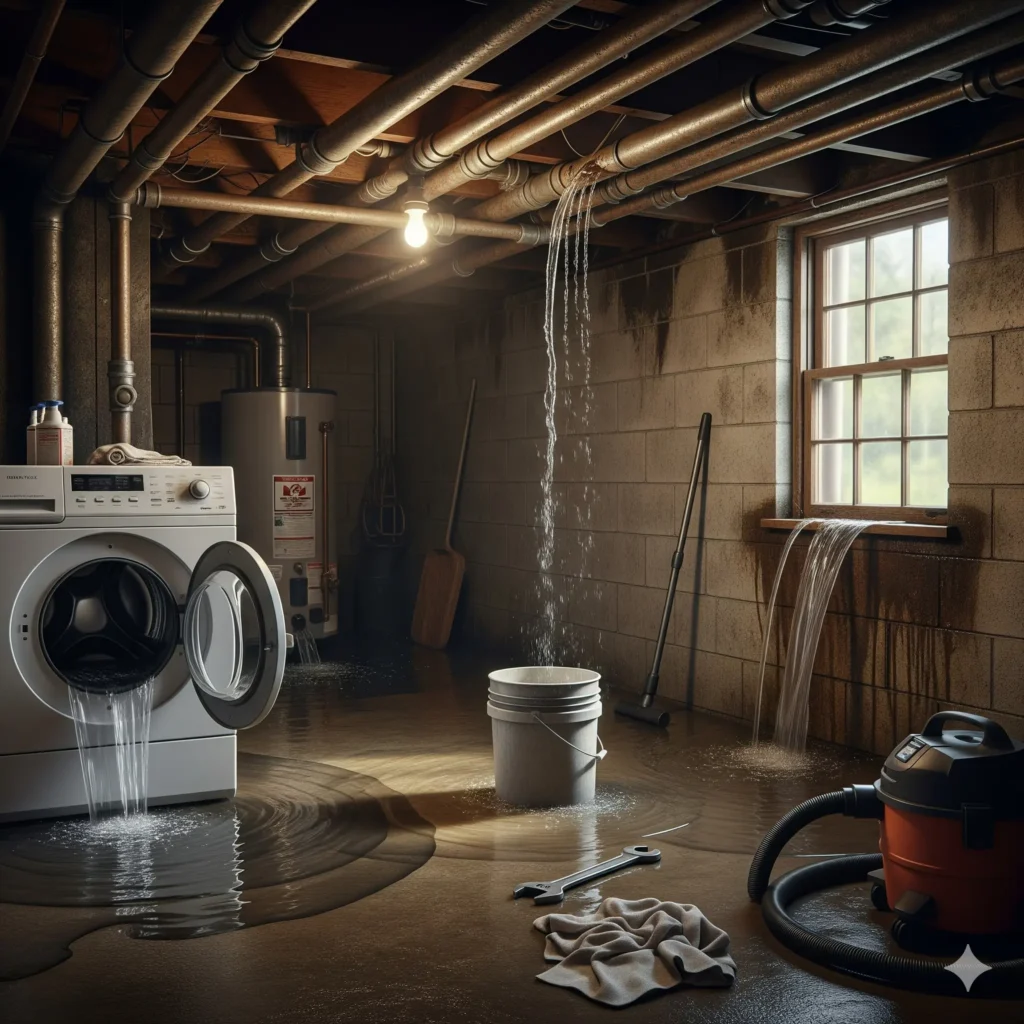
Interior sources wet a basement independent of rain: leaking supply lines, sweating cold-water pipes, failing water heaters, clogged condensate drains, and overflowing fixtures. Pipe leaks keep wetting in dry weather, while groundwater leaks follow rainfall.
Dry-to-wet progression checks, shutoff isolation, and inline pressure tests trace pipe leaks. Condensation forms when a surface temperature falls below the dew point, so sweating cold-water pipes and ducts add moisture. Closed-cell pipe insulation and a dehumidifier hold indoor relative humidity below 60%, ideally 30-50% (EPA). The diagnosis is covered in foundation leaks vs plumbing leaks.
- Inspect and log: record drips, PSI readings, and meter changes to pinpoint the loss.
- Upgrade safeguards: fit leak detectors, automatic shutoff valves, and water heater pans with drains.
- Maintain HVAC: clear condensate traps, slope lines 1/8 inch per foot, and add float switches.
Conclusion
Seven causes account for Vineland basement leaks: grading, gutters and downspouts, hydrostatic pressure, foundation cracks, sump failures, window wells, and interior plumbing. Each enters at a different point, which the types of basement leaks guide classifies by entry point, and how to fix a leaking basement covers the repairs.
Sources
- NRCS, Soil Survey of Cumberland County, NJ (Sassafras and Woodstown fine sandy loams)
- USDA NRCS Official Series Description, Woodstown
- USGS Special Report 34, Cumberland County ground water (Kirkwood-Cohansey)
- EPA, Mold Remediation in Schools and Commercial Buildings (relative humidity below 60%, ideally 30-50%)
- International Code Council, IRC R401.3 Drainage (NJ Residential Code 2021)